

Whitepaper
Scaling Without Breaking
Aligning Strategy and Structure Coherence through Enterprise Architecture (EA)
Contents
- Executive Summary
- PART I: What Organizations Should Know, Demand, and Rely On from EA
- Why Enterprise Architecture (EA)
- What EA Is Not
- What EA is
- The Role of EA
- EA as a Structural Coherence Steward
- EA as Translator Between Structure, Cost, Risk, and Strategy
- What Leaders Should Reliably Get from EA
- What Leaders Should Demand from EA
- Structural Metrics
- PART II: How Organizations Must Empower Enterprise Architecture
- Empowerment starts with a precise mandate
- Architecture cannot protect what it cannot see
- Authority in the presence of politics
- EA’s place in value delivery
- Communication: making structural health a legitimate topic
- Incentives: aligning outcomes and behavior
- The leadership commitment
- Conclusion
Executive Summary
As competition for market share intensifies, organizations push internal teams to turn wheels exponentially faster just to stay in the race. Portfolios expand from dozens to hundreds of initiatives, AI multiplies data demands, M&A stacks new systems atop legacy cores, and regulatory complexity grows.
Enterprises respond with speed and creativity, often at the cost of structural coherence and long-term alignment. Soon, “just getting it done” creates duplicated capabilities, brittle dependencies, semantic drift, and platform sprawl. By the time these cracks surface in margins, incidents, or stalled transformations, they cost orders of magnitude more to fix than to prevent.
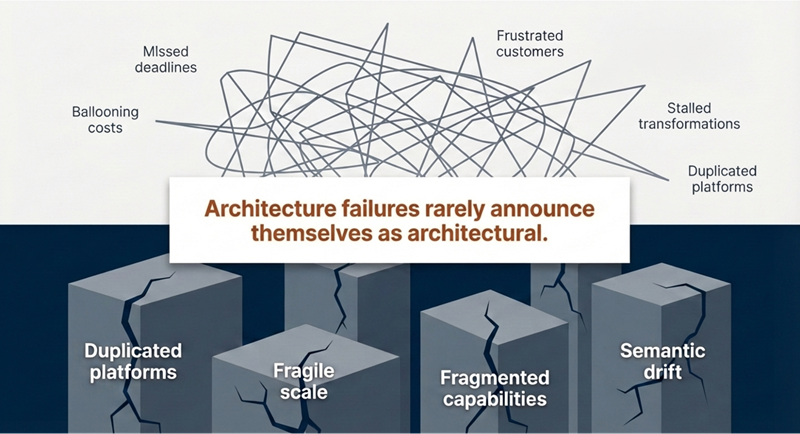
Architecture failures don’t announce themselves as architectural.
I wrote in a recent LinkedIn post: “At the executive level, most breakdowns do not announce themselves as architectural. They surface as missed deadlines, ballooning costs, duplicated platforms, fragile scale, or frustrated customers. So blame naturally lands on product or engineering teams. They are visible. They ship. They own roadmaps.”
What looks like execution failure is often structural failure. When Enterprise Architecture (EA) is sidelined, absorbed by product management and solutions architecture, or simply not invited into the room where decisions are made, organizations lose the ability to preserve intent across time, products, and scale. As I put it: “EA does not fail loudly. It fails quietly, by absence. By the absence of someone asking, early and repeatedly, ‘What must remain true as we move faster?'”
This paper answers that question directly. It reframes EA as the enterprise’s structural control system, not diagrams, ARBs, or standards decks, but the mechanism that:
- Surfaces where complexity compounds faster than value
- Makes structural risks (duplication, fragmentation, dependency concentration, semantic drift) visible before they become “execution problems”
- Preserves strategic intent as the organization moves faster
When EA works correctly, nothing feels broken. Progress feels smooth. Tradeoffs feel manageable. When EA is missing, everything feels like a product or engineering failure.
In this paper, I discuss the need for a shift from Passive EA (reviewing solutions after the fact) to Demanded EA (structural governance leaders explicitly charter). We will explore:
- What organizations should know, demand, and rely on from Enterprise Architecture
- How organizations must empower Enterprise Architecture (EA)
I am also including a more detailed list of structural risk patterns as reference (Appendix A) and a practical 6-12 month implementation playbook as guidance (Appendix B). Let’s get started!
Part I
What Organizations Should Know, Demand, and Rely On from Enterprise Architecture
1. Why Enterprise Architecture (EA)
If you do not explicitly demand EA as structural governance, you still have architecture, but you pay for the gap in hidden ways. The costs show up in five main buckets.
- Margin Erosion and Operating‑Cost Bloat
Unchecked platform proliferation, duplicated capabilities, redundant data pipelines, and fragmented experience layers drive higher maintenance, integration, and vendor costs. The enterprise pays multiple times for similar capabilities and runs more platforms than its operating model can sustain. - Slower Time‑to‑Market and Stalled Transformations
Architectural and integration debt make each new feature, product, or integration disproportionately harder. Cloud migrations, core modernizations, and M&A integrations slip from 6–12 months into multi‑year efforts, not because teams are incompetent, but because the landscape is too tangled to change safely. - Execution Risk and Fragility
Hidden dependency concentration and experience‑layer fragmentation increase outage blast radius, incident impact, and regulatory exposure. When core concepts and rules diverge across systems, even small changes can have unpredictable effects. - Strategy–Performance Gap
Without EA linking capabilities, platforms, and investments to value streams and strategic goals, capital allocation quietly funds fragmentation. Initiatives align with local product roadmaps rather than enterprise outcomes. Strategy looks coherent at the board level but loses coherence as it flows through projects and platforms. - AI and Analytics Failure Modes
If the data layer is fragmented, AI and analytics projects underperform or misbehave, not because of the models, but because the underlying architecture is incoherent. AI ends up scaling inconsistency, bias, and cost.
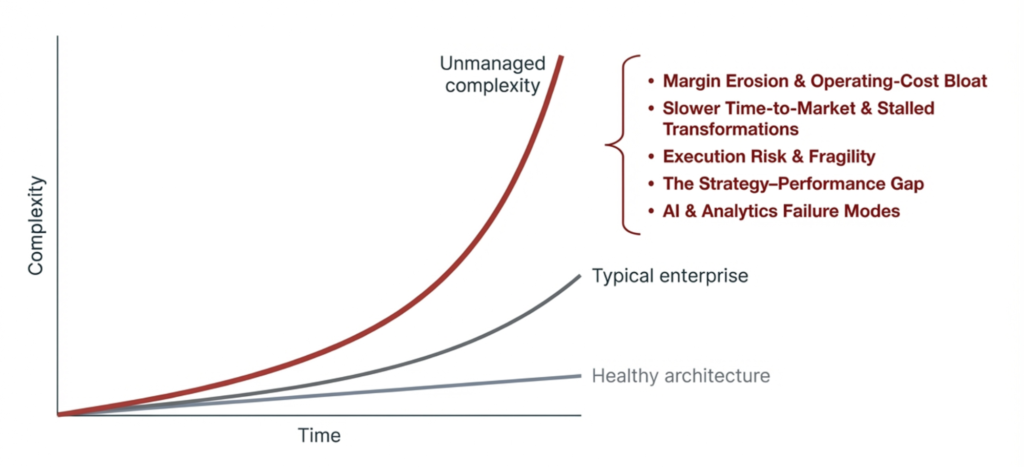
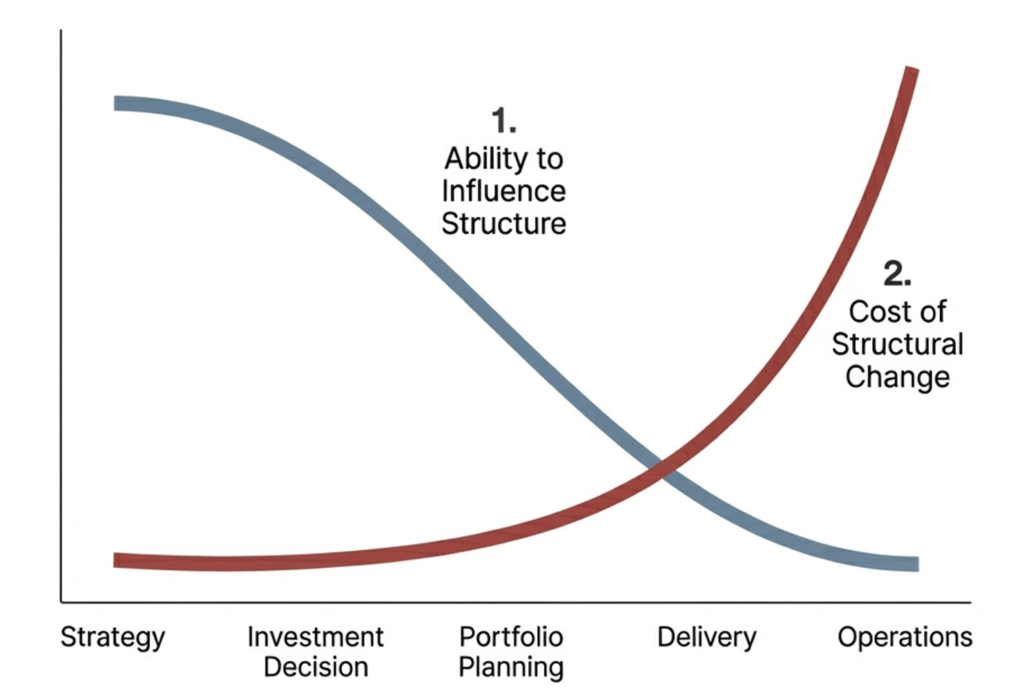
If you don’t demand EA as structural governance, you’re accepting higher unit costs, slower change, more fragile operations, and a wider gap between strategy and results. Complexity rarely arrives suddenly. It accumulates quietly until transformation becomes extremely expensive. By then, you will feel it as “execution problems” instead of “architecture problems.”
What EA Actually Is
1. What EA Is Not
EA is not:
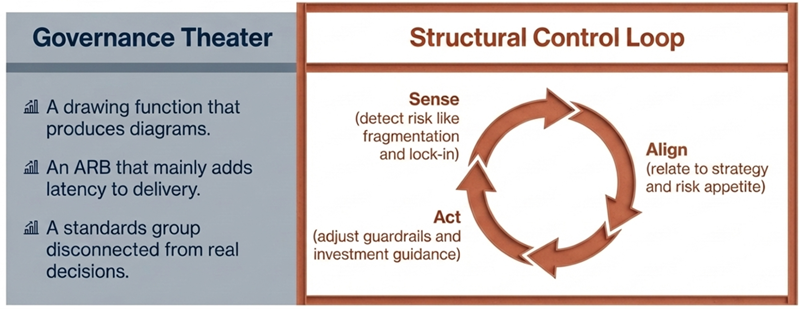
- A drawing function that produces diagrams.
- An Architecture Review Board (ARB) that mainly adds latency to delivery.
- A standards group that publishes decks, disconnected from real decisions.
Those activities matter, but only if they feed a control loop for sensing real structural risk, informing real investment choices, and changing real behaviors.
Most organizations have ARBs, standards documents, review gates, and approval workflows. But if those rituals have not improved how money is spent, which risks are reported, or what insights the board can leverage, then the question must be asked as to whether the organization truly has Structural Stewardship for its enterprise or a mere Governance Theater. More often than not, there lies the elephant in the room.
2. What EA is
A practical definition for a system architecture is: the fundamental properties of a system in its environment and the principles governing its design and evolution. In an enterprise context, EA’s job is to shape and govern those properties at scale.
To explain further, the enterprise is an ecosystem: a dynamic, interconnected network of internal organizational elements which include people and departments, process, technology, data, and culture. Think of them, not as isolated silos, but rather as “organisms” within a shared environment that rely on one another to survive, thrive, and innovate.
Enterprise Architecture (EA) ensures that these “organisms” function symbiotically to create value and adapt to change so the ecosystem, the enterprise, can thrive sustainably.
3. The role of EA
EA’s real job is not to review solutions. It is to steward the structure of the enterprise:
- Where complexity is compounding faster than value.
- Where coherence is eroding.
- Where optionality is shrinking.
- Where capital allocation is fragmenting the enterprise.
- Where AI will amplify structural weakness rather than structural strength.
If EA can answer these questions clearly and quantitatively, it becomes indispensable. If it cannot, no number of diagrams or ARB meetings will make up the difference.
EA as a Structural Coherence Steward
EA is, and should be treated as, a control system for structural coherence to:
- Sense: detect structural risks such as capability duplication, fragmentation, dependency concentration, semantic drift, lock‑in, and architectural debt.
- Align: relate what is envisioned to strategy, principles, and risk appetite.
- Act: adjust guardrails, platform strategy, capability boundaries, and investment guidance so the future looks different from the past.
Without this loop, the enterprise optimizes locally while complexity compounds globally, throwing the balance of the ecosystem increasingly off.
EA as Translator Between Structure, Cost, Risk, and Strategy
EA is one of the few functions that can:
- See the full structure: value streams, capabilities, platforms, data, dependencies.
- Understand how that structure drives cost, speed, resilience, and optionality.
- Translate those relationships into language boards and executives use: margin, risk, time‑to‑market, and strategic options.
If EA does not do this translation, leaders are effectively flying blind on structural risk.
What Leaders Should Reliably Get from EA
If EA is demanded correctly, leadership should expect four assurances.
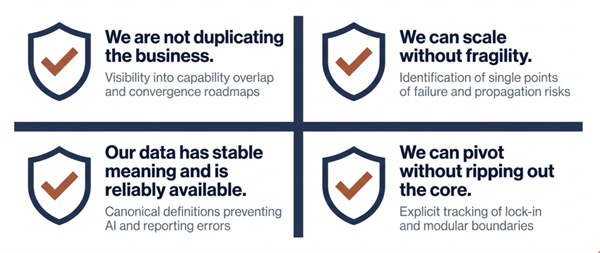
Assurance 1: “We Are Not Duplicating the Business”
EA should be able to answer:
Which capabilities exist multiple times, and why.
The cost of keeping them duplicated vs. consolidating them.
A roadmap to converge where appropriate.
Assurance 2: “We Can Scale Without Fragility”
EA should be able to show:
Where single points of failure and unsafe concentrations exist.
How outages or changes in key platforms would propagate.
What investments are planned or in flight to reduce fragility.
Assurance 3: “Our Data Has Stable Meaning and Is Reliably Available”
Enterprise Architecture should be able to demonstrate:
Canonical definitions for core entities, where systems deviate, and where authoritative sources of record reside.
The business impact of semantic deviations and data fragmentation on reporting accuracy, regulatory compliance, operational decision-making, and AI performance.
The availability posture of critical data domains, including access patterns, latency constraints, recovery expectations, and single points of failure.
A clear convergence plan to stabilize semantics and improve reliability where material risk or strategic value requires it.
Stable meaning without availability limits execution. Availability without stable meaning amplifies error. Sustainable scale requires both.
Assurance 4: “We Can Pivot Without Ripping Out the Core”
EA should be able to show:
Which decisions and platforms create lock‑in.
Where the enterprise has optionality and where it does not.
The structural work needed to make future pivots cheaper and faster.
These assurances are not “nice to have”; they are the structural precondition for reliable execution at scale.
What Leaders Should Demand from EA
The mandate of EA is to enable the enterprise to scale without breaking. To do so, it must ensure transparency into optionality and decision traceability. It must provide a full line of sight into strategic structural alignment. It must build an architectural runway that paves the way for accelerated value delivery. Most importantly, it must expose structural risks and make them visible, governable, and actionable. Below is a cheat sheet for org leaders who want to unlock full EA benefits for their enterprise.
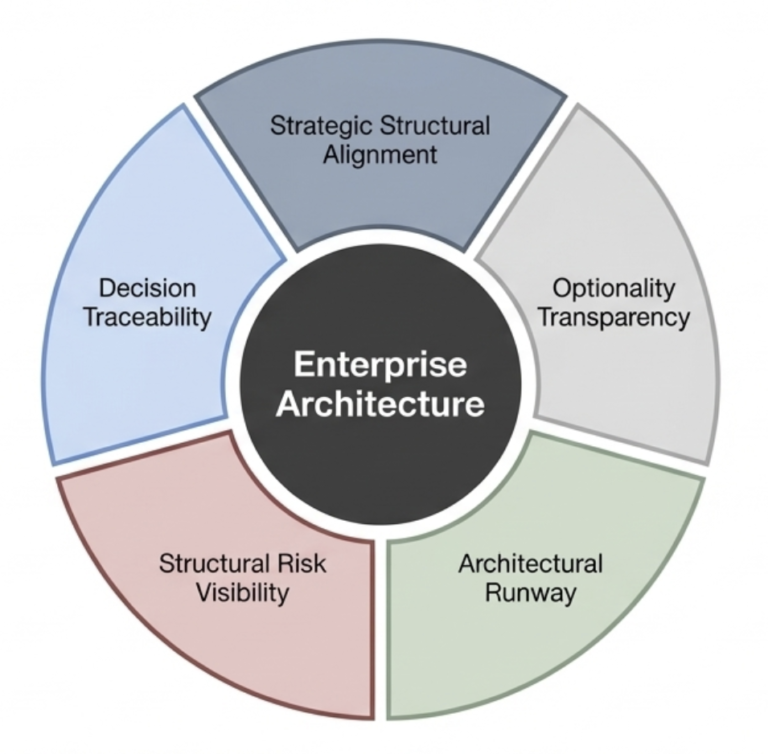
Demand 1: Coherence Ownership for Strategic Structural alignment
A named accountability point for cross‑portfolio coherence for good financial stewardship of tech investments.
EA should:
Maintain an enterprise capability map tied to budget and initiatives.
Clarify capability, data, and platform ownership.
Maintain a duplication register and fragmentation view across portfolios.
This directly addresses capability duplication, capability fragmentation, and investment misalignment.
Board‑level question: “Who is responsible for ensuring we are not accidentally building multiple versions of the same business capability, or splitting critical capabilities so no one owns them end‑to‑end?”
Demand 2: Decision Traceability
Passive EA hosts meetings. Demanded EA creates enterprise memory for defensible alignment.
EA should:
Capture material architectural decisions, with assumptions and tradeoffs.
Maintain a decision ledger that links decisions to initiatives, risks, and outcomes.
Make it easy to answer “why are we built this way?” within hours, not weeks.
This mitigates orphaned enterprise intent and helps manage architectural debt.
Board‑level questions: “When an initiative underperforms, can we trace back the structural assumptions behind it, and see which of them are now invalid? What would it take to pivot?”
Demand 3: Architectural Risk as a First‑Class Risk
If architecture is strategic, structural risk can be governed like financial and operational risk.
EA should:
Maintain a structural risk register: duplication, concentration, lock‑in, debt, drift.
Quantify these risks in business terms (cost, resilience, regulatory posture, customer harm).
Escalate when thresholds are crossed, before incidents force the issue.
This covers hidden dependency concentration, architectural debt, and AI amplification risk.
Board‑level questions: “Where could our current structure turn a single outage, regulation change, or strategy shift into a multi‑year, multi‑hundred‑million problem? What’s the breadth and severity of the impact across the enterprise?”
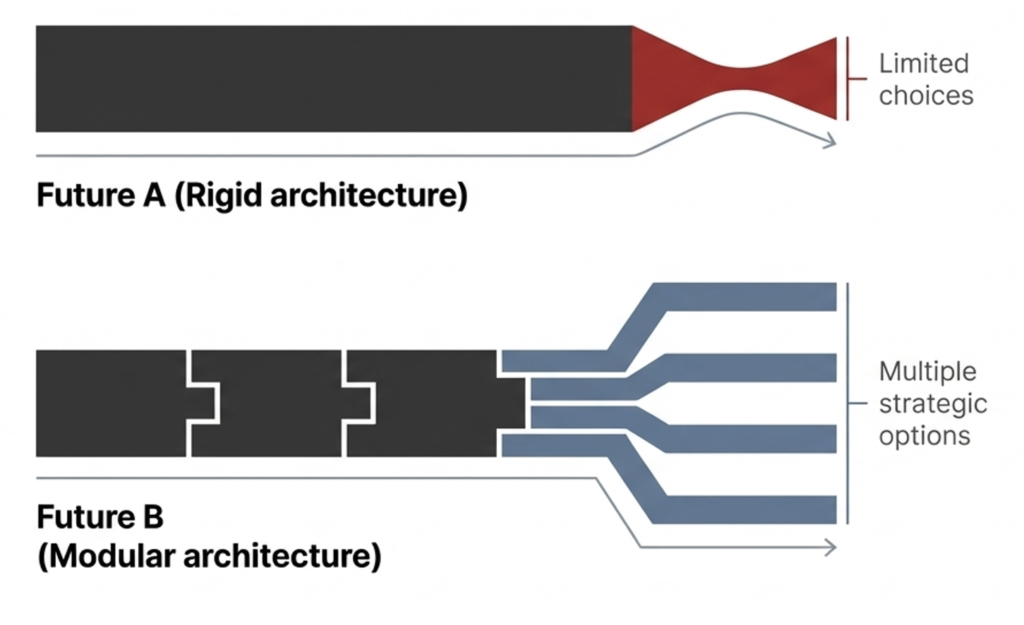
Demand 4: Optionality Transparency and Protection
Optionality is the ability to pivot, integrate acquisitions, enter new markets, swap vendors, and scale without redesign.
EA should:
Make lock‑in decisions explicit and propose alternatives where necessary.
Design and protect modular boundaries where the business needs freedom.
Track a simple lock‑in index across critical capabilities.
This confronts strategic lock‑in and platform proliferation.
Board‑level question: “What strategic options are we giving up with our current architecture, and where are we comfortable taking that risk? What opportunities does our current architecture enable us to seize?”
Demand 5: Architecture That Enables Speed
EA must be judged on whether it reduces rework and increases sustainable delivery speed.
EA should:
Publish guardrails early so teams can move fast safely.
Invest in shared primitives and platforms that reduce reinvention.
Replace “approval theater” with reusable decisions and patterns.
These address architectural debt, experience‑layer fragmentation, and cost architecture blindness.
Still, most importantly, EA must be at the helm of strategic transformation enablement with a robust architectural runway. This runway is a roadmap which EA builds after looking far (into time) and wide (for industry and competitors) into the horizon to anticipate the capabilities that the enterprise will need to enable, strengthen or retire, to ensure its desired strategic positioning.
Board‑level question: “Is our architecture making each new change easier, or harder?”
Structural Metrics
You do not need rocket-science math skills to track progress and measure success, but you need a structural view you can trend.
Here are some useful metrics to get you started:
- Duplication Index: Count of duplicated capabilities weighted by spend and customer impact.
- A rising index means future cost growth and fragmentation.
- Dependency Concentration Score: Percentage of critical journeys dependent on the top N platforms/services.
- A high score means increased blast radius for outages and changes.
- Architectural Debt Trend: Architectural debt items weighted by interest risk and remediation cost, trended monthly.
- A rising trend means slower delivery and margin erosion.
- Decision Traceability Coverage: Percentage of material decisions with recorded assumptions and owners.
- Low coverage means repeated mistakes and governance paralysis.
- Optionality / Lock‑In Index: Proportion of critical capabilities bound to single vendors, single data models, or non‑portable designs.
- A rising lock‑in means reduced strategic agility and M&A integration speed.
- Rework Rate from Structural Causes: Estimated percentage of engineering effort spent on refactors, migrations, and integration rewrites due to structural misalignment.
- A rising rate means slowdowns that look like execution failures but are actually structural.
If leadership cannot see trend lines for at least some of these, structural risk can be considered unmanaged by default.
Part II
How Organizations Must Empower Enterprise Architecture
In the first part of this paper, I described what organizations should know, demand, and rely on from Enterprise Architecture. Those expectations are only realistic if leaders are willing to change the conditions in which EA operates.
Empowerment is not a mere statement. It is a deliberate redesign of mandate, access, authority, and how the organization handles politics around structural trade‑offs. Without that redesign, EA remains present in org charts but absent from the decisions that matter.
1. Empowerment starts with a precise mandate
Most EA functions are asked to “provide architectural guidance.” That phrasing is polite, but strategically empty. It says nothing about where EA’s authority begins and ends, or how its work connects to value.
As I mentioned earlier, to be effective, EA needs a mandate, and that mandate must be explicit and testable. At minimum, leaders should make clear that Enterprise Architecture is accountable for:
- Strategic structural alignment
Translating strategy into concrete structural implications: which capabilities, platforms, and data domains must evolve for the strategy to succeed. - Architectural runway and enablement
Defining and prioritizing the structural work that allows portfolios to deliver at speed with less rework: shared primitives, platform evolution, integration and data patterns. - Structural risk visibility and escalation
Making structural risks visible in the same forums that handle financial and operational risks, and escalating them when thresholds are crossed. - Decision traceability and enterprise memory
Ensuring material architectural decisions, and their trade‑offs, are recorded and can be revisited when outcomes diverge from expectations. - Option space and lock‑in transparency
Clarifying where the organization is consciously spending optionality, and where it is unintentionally burning it.
This mandate should be adopted at the executive committee level, referenced in portfolio and risk charters, and reflected in the objectives of the COO / CIO / CDO and Chief Architect. Without it, EA will be pulled toward whatever is loudest, rather than what is structurally important.
2. Architecture cannot protect what it cannot see
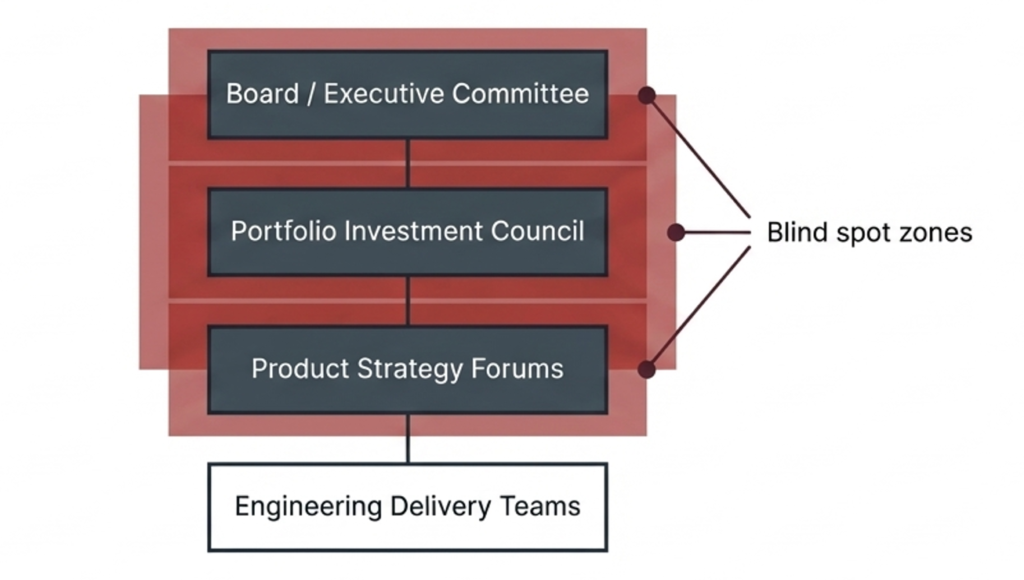
Architecture cannot protect what it is not allowed to see. Yet in many organizations, EA is routinely excluded from the earliest conversations about:
- New product lines and market entries
- Major investments and re‑platforming efforts
- M&A strategy, divestitures, and large vendor commitments
- Significant operating model or regulatory shifts
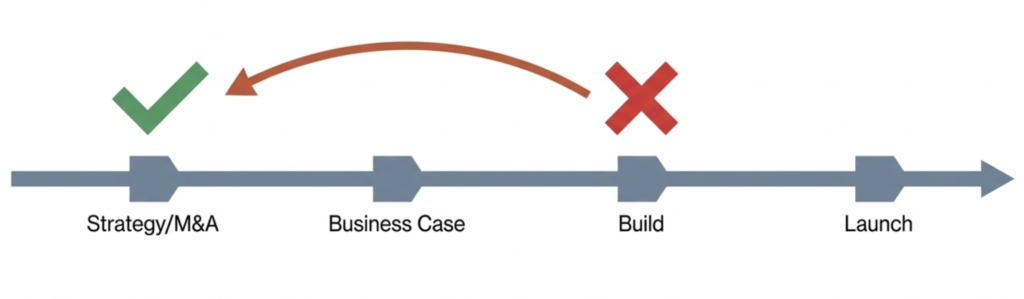
By the time EA is involved, most structural decisions have already been made, often implicitly. The function is left to comment, not to shape.
Empowerment requires systematic, early line of sight. In practice:
- EA is a standing participant in portfolio and investment forums, not an ad‑hoc guest.
- Business cases above a defined threshold contain a short “structural impact” view, developed with EA: capabilities affected, platforms touched, dependencies introduced, and potential lock‑in.
- EA has access to the same financial and risk information used by executives, so its structural analysis is grounded in real constraints and priorities.
The objective is not to insert a new approval gate. It is to ensure that when leaders decide where to place bets, they can see the structural consequences clearly.
3. Authority in the presence of politics
Structural risk is not neutral. It often implicates powerful sponsors, flagship products, and entrenched vendors. That is why EA’s work is inherently political, whether or not anyone names it that way.
Common patterns include:
- A high‑revenue product built on a fragile or over‑extended platform that no one wants to challenge.
- A region or business unit that has invested heavily in its own stack and resists convergence.
- A “strategic” vendor whose footprint quietly constrains future options.
In these situations, surfacing structural risk can be perceived as threatening careers, budgets, or narratives of success. If EA is punished, sidelined, or simply ignored when it raises these issues, the function will retreat into safe topics and generic frameworks.
Leaders who want real architecture must therefore do something uncomfortable: protect the right to name inconvenient truths.
That means:
- Stating explicitly that EA is expected to identify structural risks even when they are attached to high‑status initiatives.
- Providing a formal path for EA to bring structural concerns into executive and board‑level risk discussions.
- Treating raised risks as a shared leadership responsibility rather than “EA being difficult” or “not being a team player”.
This does not mean EA can stop initiatives by decree. It means structural risks cannot be quietly buried. When leadership chooses to accept them, that acceptance is conscious and recorded, not the by‑product of silence.
4. EA’s place in value delivery: runway and advice, not review theater
Empowered EA is not an ivory tower. It is deeply entangled with value delivery, but with a distinct lens.
A healthy pattern looks like this:
- With strategy and product
EA works upstream to translate strategic intent into a capability and platform roadmap. It helps identify which outcomes can ride existing capabilities, where new capabilities are needed, and where shared platforms should carry more of the load. Product is accountable for customer and business outcomes; EA is accountable for ensuring the structural foundation can support them. - With portfolios and delivery
EA co‑designs the architectural runway: the shared services, platforms, and data structures that make upcoming changes cheaper and safer. It identifies the minimum sequence of structural work required before, or alongside, major initiatives, and negotiates that explicitly with portfolio leadership. - With solution architecture and engineering
EA defines principles, guardrails, and target states, and serves as a strategic advisor when trade‑offs are non‑obvious. Solution architects and engineering teams design and build systems within this frame, while providing feedback about what is feasible, where guardrails need refinement, and where target states must adapt.
In this model, EA does not sit above product and engineering, nor does it sit behind them. It sits beside them, responsible for a different dimension of the same work: the long‑term structural viability of the enterprise.
5. Communication: making structural health a legitimate topic
Part of empowerment is cultural. Structural topics are often treated as “too technical” for executive discussion, or as a distraction from financial and commercial narratives. As a result, structural concerns are pushed into side conversations, where they compete poorly with urgent delivery issues.
To change this, leaders must normalize structural language in mainstream forums. I offered some board-level questions earlier in the paper. Below are some practical conversations which must be held at all levels of the organization, at every step of the transformation journey:
- When strategy is communicated, explicitly address what must change in structure for the strategy to be real: which capabilities must be strengthened, which platforms must evolve, and where optionality must be preserved.
- In portfolio reviews, ask not only “Are we delivering?” but also “What did this work do to our structure? Did it simplify or complicate our future?”
- After major incidents or failed programs, require a structural perspective in post‑mortems: which architectural choices contributed, and what will be done differently.
EA cannot create this environment alone. It depends on leaders signalling that structural content is legitimate, expected, and valued in the same way financial and risk content is.
6. Incentives: aligning outcomes and behavior
If executives and teams are measured solely on short‑term delivery and financial metrics, structural concerns will always lose. Empowerment therefore includes aligning incentives with the structural outcomes EA is chartered to protect.
In practice, this can mean:
- Incorporating structural indicators, such as duplication, unsafe dependency concentration, or architectural debt trends, into the objectives of senior product and technology leaders.
- Defining EA’s success in terms of structural visibility and improvement, not the volume of documentation, the number of meetings held, or the number of “blocks” issued.
- Periodically reviewing a small structural scorecard in the same forums that review financial performance and operational incidents.
The intent is not to drown the organization in new metrics, but to make visible that structural health is part of performance, not orthogonal to it.
7. The leadership commitment
EA’s success ultimately comes down to the leadership posture.
Leaders who want EA to do more than decorate slide decks must be willing to:
- Give it a mandate that includes real responsibility.
- Allow it to see and analyze the decisions that shape structure.
- Protect its right to surface structural risk in politically sensitive areas.
- Position it as a partner in value delivery, designing the runway rather than adjudicating from the sidelines.
- Speak about structural health as a normal aspect of running the enterprise, not as an occasional technical aside.
If you hold executive authority, the question is not whether you “support” EA, but whether you are prepared to let it impact how decisions are made.
Choose one upcoming forum you control, be it a portfolio review, an investment committee, a strategy offsite and do three things:
- Put EA in the room with a clear remit to speak to structural implications.
- Ask at least one structural question out loud: “What does this do to our options, our dependencies, or our ability to change later?”
- Record any structural risks you decide to accept, so they are conscious choices, not blind spots.
The moment you do this consistently, EA stops being an ornamental function and becomes a practical instrument for scaling without breaking.
Conclusion
Scaling without breaking is a shared obligation.
Organizational leaders must do more than sponsor Enterprise Architecture in name. They must empower it with a clear mandate, visibility into investment decisions, and the authority to surface structural risk without political friction. Architecture cannot protect what it is not allowed to see.
With trust comes responsibility. Enterprise Architects must in turn earn that mandate. They must translate structure into economic consequence, speak fluently in the language of capital allocation and risk exposure, and demonstrate measurable impact on coherence, speed, and resilience.
Trust is not automatic. It is built through clarity, discipline, and results.
When leaders empower and architects deliver, Enterprise Architecture becomes what it was always meant to be: the structural steward of sustainable scale.
If your organization is scaling, transforming, or investing in AI, send me a note at linda@qavaainnovate.com. Let’s exchange ideas on how best to diagnose structural risk, clarify coherence ownership, and design governance models that enable sustainable speed in your organization.
Executive Summary
As competition for market share intensifies, organizations push internal teams to turn wheels exponentially faster just to stay in the race. Portfolios expand from dozens to hundreds of initiatives, AI multiplies data demands, M&A stacks new systems atop legacy cores, and regulatory complexity grows.
Enterprises respond with speed and creativity, often at the cost of structural coherence and long-term alignment. Soon, “just getting it done” creates duplicated capabilities, brittle dependencies, semantic drift, and platform sprawl. By the time these cracks surface in margins, incidents, or stalled transformations, they cost orders of magnitude more to fix than to prevent.
Architecture failures don’t announce themselves as architectural.
I wrote in a recent LinkedIn post: “At the executive level, most breakdowns do not announce themselves as architectural. They surface as missed deadlines, ballooning costs, duplicated platforms, fragile scale, or frustrated customers. So blame naturally lands on product or engineering teams. They are visible. They ship. They own roadmaps.”
What looks like execution failure is often structural failure. When Enterprise Architecture (EA) is sidelined, absorbed by product management and solutions architecture, or simply not invited into the room where decisions are made, organizations lose the ability to preserve intent across time, products, and scale. As I put it: “EA does not fail loudly. It fails quietly, by absence. By the absence of someone asking, early and repeatedly, ‘What must remain true as we move faster?'”
This paper answers that question directly. It reframes EA as the enterprise’s structural control system, not diagrams, ARBs, or standards decks, but the mechanism that:
- Surfaces where complexity compounds faster than value
- Makes structural risks (duplication, fragmentation, dependency concentration, semantic drift) visible before they become “execution problems”
- Preserves strategic intent as the organization moves faster
When EA works correctly, nothing feels broken. Progress feels smooth. Tradeoffs feel manageable. When EA is missing, everything feels like a product or engineering failure.
In this paper, I discuss the need for a shift from Passive EA (reviewing solutions after the fact) to Demanded EA (structural governance leaders explicitly charter). We will explore:
- What organizations should know, demand, and rely on from Enterprise Architecture
- How organizations must empower Enterprise Architecture (EA)
I am also including a more detailed list of structural risk patterns as reference (Appendix A) and a practical 6-12 month implementation playbook as guidance (Appendix B). Let’s get started!
Part I
What Organizations Should Know, Demand, and Rely On from Enterprise Architecture
1. Why Enterprise Architecture (EA)
If you do not explicitly demand EA as structural governance, you still have architecture, but you pay for the gap in hidden ways. The costs show up in five main buckets.
- Margin Erosion and Operating‑Cost Bloat
Unchecked platform proliferation, duplicated capabilities, redundant data pipelines, and fragmented experience layers drive higher maintenance, integration, and vendor costs. The enterprise pays multiple times for similar capabilities and runs more platforms than its operating model can sustain. - Slower Time‑to‑Market and Stalled Transformations
Architectural and integration debt make each new feature, product, or integration disproportionately harder. Cloud migrations, core modernizations, and M&A integrations slip from 6–12 months into multi‑year efforts, not because teams are incompetent, but because the landscape is too tangled to change safely. - Execution Risk and Fragility
Hidden dependency concentration and experience‑layer fragmentation increase outage blast radius, incident impact, and regulatory exposure. When core concepts and rules diverge across systems, even small changes can have unpredictable effects. - Strategy–Performance Gap
Without EA linking capabilities, platforms, and investments to value streams and strategic goals, capital allocation quietly funds fragmentation. Initiatives align with local product roadmaps rather than enterprise outcomes. Strategy looks coherent at the board level but loses coherence as it flows through projects and platforms. - AI and Analytics Failure Modes
If the data layer is fragmented, AI and analytics projects underperform or misbehave, not because of the models, but because the underlying architecture is incoherent. AI ends up scaling inconsistency, bias, and cost.
If you don’t demand EA as structural governance, you’re accepting higher unit costs, slower change, more fragile operations, and a wider gap between strategy and results. Complexity rarely arrives suddenly. It accumulates quietly until transformation becomes extremely expensive. By then, you will feel it as “execution problems” instead of “architecture problems.”
What EA Actually Is
1. What EA Is Not
EA is not:
- A drawing function that produces diagrams.
- An Architecture Review Board (ARB) that mainly adds latency to delivery.
- A standards group that publishes decks, disconnected from real decisions.
Those activities matter, but only if they feed a control loop for sensing real structural risk, informing real investment choices, and changing real behaviors.
Most organizations have ARBs, standards documents, review gates, and approval workflows. But if those rituals have not improved how money is spent, which risks are reported, or what insights the board can leverage, then the question must be asked as to whether the organization truly has Structural Stewardship for its enterprise or a mere Governance Theater. More often than not, there lies the elephant in the room.
2. What EA is
A practical definition for a system architecture is: the fundamental properties of a system in its environment and the principles governing its design and evolution. In an enterprise context, EA’s job is to shape and govern those properties at scale.
To explain further, the enterprise is an ecosystem: a dynamic, interconnected network of internal organizational elements which include people and departments, process, technology, data, and culture. Think of them, not as isolated silos, but rather as “organisms” within a shared environment that rely on one another to survive, thrive, and innovate.
Enterprise Architecture (EA) ensures that these “organisms” function symbiotically to create value and adapt to change so the ecosystem, the enterprise, can thrive sustainably.
3. The role of EA
EA’s real job is not to review solutions. It is to steward the structure of the enterprise:
- Where complexity is compounding faster than value.
- Where coherence is eroding.
- Where optionality is shrinking.
- Where capital allocation is fragmenting the enterprise.
- Where AI will amplify structural weakness rather than structural strength.
If EA can answer these questions clearly and quantitatively, it becomes indispensable. If it cannot, no number of diagrams or ARB meetings will make up the difference.
EA as a Structural Coherence Steward
EA is, and should be treated as, a control system for structural coherence to:
- Sense: detect structural risks such as capability duplication, fragmentation, dependency concentration, semantic drift, lock‑in, and architectural debt.
- Align: relate what is envisioned to strategy, principles, and risk appetite.
- Act: adjust guardrails, platform strategy, capability boundaries, and investment guidance so the future looks different from the past.
Without this loop, the enterprise optimizes locally while complexity compounds globally, throwing the balance of the ecosystem increasingly off.
EA as Translator Between Structure, Cost, Risk, and Strategy
EA is one of the few functions that can:
- See the full structure: value streams, capabilities, platforms, data, dependencies.
- Understand how that structure drives cost, speed, resilience, and optionality.
- Translate those relationships into language boards and executives use: margin, risk, time‑to‑market, and strategic options.
If EA does not do this translation, leaders are effectively flying blind on structural risk.
What Leaders Should Reliably Get from EA
If EA is demanded correctly, leadership should expect four assurances.
Assurance 1: “We Are Not Duplicating the Business”
EA should be able to answer:
Which capabilities exist multiple times, and why.
The cost of keeping them duplicated vs. consolidating them.
A roadmap to converge where appropriate.
Assurance 2: “We Can Scale Without Fragility”
EA should be able to show:
Where single points of failure and unsafe concentrations exist.
How outages or changes in key platforms would propagate.
What investments are planned or in flight to reduce fragility.
Assurance 3: “Our Data Has Stable Meaning and Is Reliably Available”
Enterprise Architecture should be able to demonstrate:
Canonical definitions for core entities, where systems deviate, and where authoritative sources of record reside.
The business impact of semantic deviations and data fragmentation on reporting accuracy, regulatory compliance, operational decision-making, and AI performance.
The availability posture of critical data domains, including access patterns, latency constraints, recovery expectations, and single points of failure.
A clear convergence plan to stabilize semantics and improve reliability where material risk or strategic value requires it.
Stable meaning without availability limits execution. Availability without stable meaning amplifies error. Sustainable scale requires both.
Assurance 4: “We Can Pivot Without Ripping Out the Core”
EA should be able to show:
Which decisions and platforms create lock‑in.
Where the enterprise has optionality and where it does not.
The structural work needed to make future pivots cheaper and faster.
These assurances are not “nice to have”; they are the structural precondition for reliable execution at scale.
What Leaders Should Demand from EA
The mandate of EA is to enable the enterprise to scale without breaking. To do so, it must ensure transparency into optionality and decision traceability. It must provide a full line of sight into strategic structural alignment. It must build an architectural runway that paves the way for accelerated value delivery. Most importantly, it must expose structural risks and make them visible, governable, and actionable. Below is a cheat sheet for org leaders who want to unlock full EA benefits for their enterprise.
Demand 1: Coherence Ownership for Strategic Structural alignment
A named accountability point for cross‑portfolio coherence for good financial stewardship of tech investments.
EA should:
Maintain an enterprise capability map tied to budget and initiatives.
Clarify capability, data, and platform ownership.
Maintain a duplication register and fragmentation view across portfolios.
This directly addresses capability duplication, capability fragmentation, and investment misalignment.
Board‑level question: “Who is responsible for ensuring we are not accidentally building multiple versions of the same business capability, or splitting critical capabilities so no one owns them end‑to‑end?”
Demand 2: Decision Traceability
Passive EA hosts meetings. Demanded EA creates enterprise memory for defensible alignment.
EA should:
Capture material architectural decisions, with assumptions and tradeoffs.
Maintain a decision ledger that links decisions to initiatives, risks, and outcomes.
Make it easy to answer “why are we built this way?” within hours, not weeks.
This mitigates orphaned enterprise intent and helps manage architectural debt.
Board‑level questions: “When an initiative underperforms, can we trace back the structural assumptions behind it, and see which of them are now invalid? What would it take to pivot?”
Demand 3: Architectural Risk as a First‑Class Risk
If architecture is strategic, structural risk can be governed like financial and operational risk.
EA should:
Maintain a structural risk register: duplication, concentration, lock‑in, debt, drift.
Quantify these risks in business terms (cost, resilience, regulatory posture, customer harm).
Escalate when thresholds are crossed, before incidents force the issue.
This covers hidden dependency concentration, architectural debt, and AI amplification risk.
Board‑level questions: “Where could our current structure turn a single outage, regulation change, or strategy shift into a multi‑year, multi‑hundred‑million problem? What’s the breadth and severity of the impact across the enterprise?”
Demand 4: Optionality Transparency and Protection
Optionality is the ability to pivot, integrate acquisitions, enter new markets, swap vendors, and scale without redesign.
EA should:
Make lock‑in decisions explicit and propose alternatives where necessary.
Design and protect modular boundaries where the business needs freedom.
Track a simple lock‑in index across critical capabilities.
This confronts strategic lock‑in and platform proliferation.
Board‑level question: “What strategic options are we giving up with our current architecture, and where are we comfortable taking that risk? What opportunities does our current architecture enable us to seize?”
Demand 5: Architecture That Enables Speed
EA must be judged on whether it reduces rework and increases sustainable delivery speed.
EA should:
Publish guardrails early so teams can move fast safely.
Invest in shared primitives and platforms that reduce reinvention.
Replace “approval theater” with reusable decisions and patterns.
These address architectural debt, experience‑layer fragmentation, and cost architecture blindness.
Still, most importantly, EA must be at the helm of strategic transformation enablement with a robust architectural runway. This runway is a roadmap which EA builds after looking far (into time) and wide (for industry and competitors) into the horizon to anticipate the capabilities that the enterprise will need to enable, strengthen or retire, to ensure its desired strategic positioning.
Board‑level question: “Is our architecture making each new change easier, or harder?”
Structural Metrics
You do not need rocket-science math skills to track progress and measure success, but you need a structural view you can trend.
Here are some useful metrics to get you started:
- Duplication Index: Count of duplicated capabilities weighted by spend and customer impact.
- A rising index means future cost growth and fragmentation.
- Dependency Concentration Score: Percentage of critical journeys dependent on the top N platforms/services.
- A high score means increased blast radius for outages and changes.
- Architectural Debt Trend: Architectural debt items weighted by interest risk and remediation cost, trended monthly.
- A rising trend means slower delivery and margin erosion.
- Decision Traceability Coverage: Percentage of material decisions with recorded assumptions and owners.
- Low coverage means repeated mistakes and governance paralysis.
- Optionality / Lock‑In Index: Proportion of critical capabilities bound to single vendors, single data models, or non‑portable designs.
- A rising lock‑in means reduced strategic agility and M&A integration speed.
- Rework Rate from Structural Causes: Estimated percentage of engineering effort spent on refactors, migrations, and integration rewrites due to structural misalignment.
- A rising rate means slowdowns that look like execution failures but are actually structural.
If leadership cannot see trend lines for at least some of these, structural risk can be considered unmanaged by default.
Part II
How Organizations Must Empower Enterprise Architecture
In the first part of this paper, I described what organizations should know, demand, and rely on from Enterprise Architecture. Those expectations are only realistic if leaders are willing to change the conditions in which EA operates.
Empowerment is not a mere statement. It is a deliberate redesign of mandate, access, authority, and how the organization handles politics around structural trade‑offs. Without that redesign, EA remains present in org charts but absent from the decisions that matter.
1. Empowerment starts with a precise mandate
Most EA functions are asked to “provide architectural guidance.” That phrasing is polite, but strategically empty. It says nothing about where EA’s authority begins and ends, or how its work connects to value.
As I mentioned earlier, to be effective, EA needs a mandate, and that mandate must be explicit and testable. At minimum, leaders should make clear that Enterprise Architecture is accountable for:
- Strategic structural alignment
Translating strategy into concrete structural implications: which capabilities, platforms, and data domains must evolve for the strategy to succeed. - Architectural runway and enablement
Defining and prioritizing the structural work that allows portfolios to deliver at speed with less rework: shared primitives, platform evolution, integration and data patterns. - Structural risk visibility and escalation
Making structural risks visible in the same forums that handle financial and operational risks, and escalating them when thresholds are crossed. - Decision traceability and enterprise memory
Ensuring material architectural decisions, and their trade‑offs, are recorded and can be revisited when outcomes diverge from expectations. - Option space and lock‑in transparency
Clarifying where the organization is consciously spending optionality, and where it is unintentionally burning it.
This mandate should be adopted at the executive committee level, referenced in portfolio and risk charters, and reflected in the objectives of the COO / CIO / CDO and Chief Architect. Without it, EA will be pulled toward whatever is loudest, rather than what is structurally important.
2. Architecture cannot protect what it cannot see
Architecture cannot protect what it is not allowed to see. Yet in many organizations, EA is routinely excluded from the earliest conversations about:
- New product lines and market entries
- Major investments and re‑platforming efforts
- M&A strategy, divestitures, and large vendor commitments
- Significant operating model or regulatory shifts
By the time EA is involved, most structural decisions have already been made, often implicitly. The function is left to comment, not to shape.
Empowerment requires systematic, early line of sight. In practice:
- EA is a standing participant in portfolio and investment forums, not an ad‑hoc guest.
- Business cases above a defined threshold contain a short “structural impact” view, developed with EA: capabilities affected, platforms touched, dependencies introduced, and potential lock‑in.
- EA has access to the same financial and risk information used by executives, so its structural analysis is grounded in real constraints and priorities.
The objective is not to insert a new approval gate. It is to ensure that when leaders decide where to place bets, they can see the structural consequences clearly.
3. Authority in the presence of politics
Structural risk is not neutral. It often implicates powerful sponsors, flagship products, and entrenched vendors. That is why EA’s work is inherently political, whether or not anyone names it that way.
Common patterns include:
- A high‑revenue product built on a fragile or over‑extended platform that no one wants to challenge.
- A region or business unit that has invested heavily in its own stack and resists convergence.
- A “strategic” vendor whose footprint quietly constrains future options.
In these situations, surfacing structural risk can be perceived as threatening careers, budgets, or narratives of success. If EA is punished, sidelined, or simply ignored when it raises these issues, the function will retreat into safe topics and generic frameworks.
Leaders who want real architecture must therefore do something uncomfortable: protect the right to name inconvenient truths.
That means:
- Stating explicitly that EA is expected to identify structural risks even when they are attached to high‑status initiatives.
- Providing a formal path for EA to bring structural concerns into executive and board‑level risk discussions.
- Treating raised risks as a shared leadership responsibility rather than “EA being difficult” or “not being a team player”.
This does not mean EA can stop initiatives by decree. It means structural risks cannot be quietly buried. When leadership chooses to accept them, that acceptance is conscious and recorded, not the by‑product of silence.
4. EA’s place in value delivery: runway and advice, not review theater
Empowered EA is not an ivory tower. It is deeply entangled with value delivery, but with a distinct lens.
A healthy pattern looks like this:
- With strategy and product
EA works upstream to translate strategic intent into a capability and platform roadmap. It helps identify which outcomes can ride existing capabilities, where new capabilities are needed, and where shared platforms should carry more of the load. Product is accountable for customer and business outcomes; EA is accountable for ensuring the structural foundation can support them. - With portfolios and delivery
EA co‑designs the architectural runway: the shared services, platforms, and data structures that make upcoming changes cheaper and safer. It identifies the minimum sequence of structural work required before, or alongside, major initiatives, and negotiates that explicitly with portfolio leadership. - With solution architecture and engineering
EA defines principles, guardrails, and target states, and serves as a strategic advisor when trade‑offs are non‑obvious. Solution architects and engineering teams design and build systems within this frame, while providing feedback about what is feasible, where guardrails need refinement, and where target states must adapt.
In this model, EA does not sit above product and engineering, nor does it sit behind them. It sits beside them, responsible for a different dimension of the same work: the long‑term structural viability of the enterprise.
5. Communication: making structural health a legitimate topic
Part of empowerment is cultural. Structural topics are often treated as “too technical” for executive discussion, or as a distraction from financial and commercial narratives. As a result, structural concerns are pushed into side conversations, where they compete poorly with urgent delivery issues.
To change this, leaders must normalize structural language in mainstream forums. I offered some board-level questions earlier in the paper. Below are some practical conversations which must be held at all levels of the organization, at every step of the transformation journey:
- When strategy is communicated, explicitly address what must change in structure for the strategy to be real: which capabilities must be strengthened, which platforms must evolve, and where optionality must be preserved.
- In portfolio reviews, ask not only “Are we delivering?” but also “What did this work do to our structure? Did it simplify or complicate our future?”
- After major incidents or failed programs, require a structural perspective in post‑mortems: which architectural choices contributed, and what will be done differently.
EA cannot create this environment alone. It depends on leaders signalling that structural content is legitimate, expected, and valued in the same way financial and risk content is.
6. Incentives: aligning outcomes and behavior
If executives and teams are measured solely on short‑term delivery and financial metrics, structural concerns will always lose. Empowerment therefore includes aligning incentives with the structural outcomes EA is chartered to protect.
In practice, this can mean:
- Incorporating structural indicators, such as duplication, unsafe dependency concentration, or architectural debt trends, into the objectives of senior product and technology leaders.
- Defining EA’s success in terms of structural visibility and improvement, not the volume of documentation, the number of meetings held, or the number of “blocks” issued.
- Periodically reviewing a small structural scorecard in the same forums that review financial performance and operational incidents.
The intent is not to drown the organization in new metrics, but to make visible that structural health is part of performance, not orthogonal to it.
7. The leadership commitment
EA’s success ultimately comes down to the leadership posture.
Leaders who want EA to do more than decorate slide decks must be willing to:
- Give it a mandate that includes real responsibility.
- Allow it to see and analyze the decisions that shape structure.
- Protect its right to surface structural risk in politically sensitive areas.
- Position it as a partner in value delivery, designing the runway rather than adjudicating from the sidelines.
- Speak about structural health as a normal aspect of running the enterprise, not as an occasional technical aside.
If you hold executive authority, the question is not whether you “support” EA, but whether you are prepared to let it impact how decisions are made.
Choose one upcoming forum you control, be it a portfolio review, an investment committee, a strategy offsite and do three things:
- Put EA in the room with a clear remit to speak to structural implications.
- Ask at least one structural question out loud: “What does this do to our options, our dependencies, or our ability to change later?”
- Record any structural risks you decide to accept, so they are conscious choices, not blind spots.
The moment you do this consistently, EA stops being an ornamental function and becomes a practical instrument for scaling without breaking.
Conclusion
Scaling without breaking is a shared obligation.
Organizational leaders must do more than sponsor Enterprise Architecture in name. They must empower it with a clear mandate, visibility into investment decisions, and the authority to surface structural risk without political friction. Architecture cannot protect what it is not allowed to see.
With trust comes responsibility. Enterprise Architects must in turn earn that mandate. They must translate structure into economic consequence, speak fluently in the language of capital allocation and risk exposure, and demonstrate measurable impact on coherence, speed, and resilience.
Trust is not automatic. It is built through clarity, discipline, and results.
When leaders empower and architects deliver, Enterprise Architecture becomes what it was always meant to be: the structural steward of sustainable scale.
If your organization is scaling, transforming, or investing in AI, send me a note at linda@qavaainnovate.com. Let’s exchange ideas on how best to diagnose structural risk, clarify coherence ownership, and design governance models that enable sustainable speed in your organization.
- Executive Summary
- Why Enterprise Architecture (EA)
- What EA Is Not
- What EA is
- The Role of EA
- EA as a Structural Coherence Steward
- EA as Translator Between Structure, Cost, Risk, and Strategy
- What Leaders Should Reliably Get from EA
- What Leaders Should Demand from EA
- Structural Metrics
- Empowerment starts with a precise mandate
- Architecture cannot protect what it cannot see
- Authority in the presence of politics
- EA’s place in value delivery
- Communication: making structural health a legitimate topic
- Incentives: aligning outcomes and behavior
- The leadership commitment
- Conclusion